Hello, I'm Cristina Baciu
Areas of Focus
Research Development & Faculty Support
In my role as Assistant Director of Research at the W. P. Carey School of Business at Arizona State University, I support school-wide research initiatives, faculty scholarship, interdisciplinary collaboration, and research capacity-building. My work includes helping researchers identify funding opportunities, strengthen proposals, build collaborations, and develop strategic approaches to advancing research impact.
I am especially interested in how schools, departments, and institutions can build research ecosystems that are proactive, connected, and responsive to faculty needs.
Mentoring & E-Mentoring
Mentoring has been a central thread across my career. I use the term mentoring broadly to include in-person mentoring, e-mentoring, peer mentoring, group mentoring, and other forms of structured developmental support.
My work examines how mentoring can build community, strengthen persistence, support professional identity development, and help students navigate complex academic and career pathways. I am especially interested in how digital and hybrid mentoring can expand access to support for students who may not fit traditional assumptions about campus life, including online students, adult learners, first-generation students, international students, working students, and students balancing family responsibilities.
My forthcoming book, Beyond the Campus: The Power of E-Mentoring in Modern Higher Education, co-authored with Blue Brazelton, explores how e-mentoring can help higher education institutions build more intentional, inclusive, and sustainable systems of support.
Student Success & Belonging
I believe student success is not only about academic performance. It is also about connection, confidence, identity, access to information, and the presence of people who help students see possible futures.
Through my mentoring programs, research, and professional practice, I focus on creating structures that help students feel supported, build skills, access opportunities, and persist through uncertainty.
AI, Mentoring & the Future of Higher Education
I am increasingly interested in how artificial intelligence is changing the way students, faculty, and professionals seek guidance, build relationships, and develop their careers.
My work in this area asks how AI can support — but not replace — human connection. I am especially interested in how mentors and mentees can use AI thoughtfully to improve preparation, reflection, communication, and professional development while preserving trust, care, and relational depth.
MENTORING PROGRAMS
These programs are offered at Arizona State University. We value Collaboration, Communication, and Community.

The Arizona Cancer Evolution (ACE) Scholars Program
Read our paper about the program - DOWNLOAD PDF
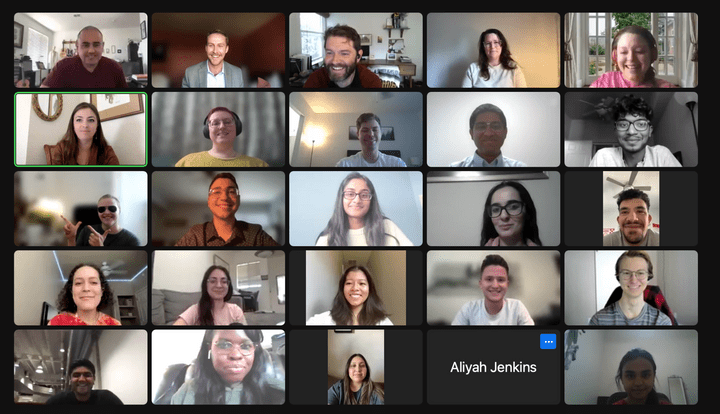
I co-founded the ACE Scholars Program in 2021 through the Arizona Cancer Evolution Center at ASU. The program combines scientific mentoring, research training, R statistics tutorials, professional development, and community-building for both in-person and online students. For more information, please visit our website.

The Cooperation Scholars Program
Read an example syllabus here.
I co-founded the Cooperation Scholars Program in 2022 through the Cooperation Lab and Cooperation Science Network, both directed by Dr. Athena Aktipis at ASU. The program introduces students to cooperation science, research methods, interdisciplinary inquiry, and professional development.

The Zombified Media Z-team
I co-founded the Zombified Media Z-team in the Fall of 2020 at ASU. The Z-team is offered through Zombified Media, an educational non-profit that uses new media to create educational content and communicate with broad audiences.
The Z-team provides students with science communication and outreach training as well we content creation and professional development.Selected publications
Baciu, C. (2026). Reframing mentoring in higher education as a cooperative system: Four principles for inclusive and sustainable development.
Frontiers in Education, 11, 1819548.
doi: 10.3389/feduc.2026.1819548
This article reframes mentoring as a cooperative system and proposes four principles for building mentoring relationships and programs that are inclusive, sustainable, and developmentally meaningful.
Baciu C., Mohan G., & Wilson J. (2026). Algorithmic scholarship and academic evaluation: governance misalignment in the age of generative AI.
Front. Artif. Intell. 9:1862980.
doi: 10.3389/frai.2026.1862980
This study examines how generative AI is reshaping scholarly authorship, productivity, and accountability, and argues that universities must rethink how academic contributions are evaluated as these tools become more widely used.
Enriquez, P., Lin, H-Y., & Baciu, C. (2026). Artificial intelligence in higher education: Student use, perceived benefits, and emerging risks.
Frontiers in Education, 11, 1812390.
doi: 10.3389/feduc.2026.1812390
This article examines how students are using artificial intelligence in higher education, including perceived benefits, emerging risks, and implications for teaching, learning, and academic support.
Examining e-mentoring: Factors That Influence Online Undergraduate Students' Perceptions of E-Mentoring
This paper represents a part of my dissertation work. Here we find that digital competence and goal orientation are significant predictors of students' perceptions of e-mentoring.
The ACE Scholars Program: An Integrative Approach to Undergraduate Research Training
In this paper, we introduce the ACE Scholars Program, discussing the theory behind it (project and team-based learning), as well as program evaluation and students' statements of impact.
Wagge, J. R., Baciu, C., Banas, K., Nadler, J. T., Schwarz, S., Weisberg, Y., IJzerman, H., Legate, N., & Grahe, J. (2019). A demonstration of the Collaborative Replication and Education Project: Replication attempts of the red-romance effect.
Collabra: Psychology, 5(1).
https://doi.org/10.17605/OSF.IO/CHAX8
This collaborative replication project reflects my early work in open science, research training, and collaborative approaches to psychological science.
Aktipis, A., Cronk, L., Alcock, J., Ayers, J. D., Baciu, C., Balliet, D., Boddy, A. M., Curry, O. S., Krems, J. A., Muñoz, A., Sullivan, D., Sznycer, D., Wilkinson, G. S., & Winfrey, P. (2018). Understanding cooperation through fitness interdependence.
Nature Human Behaviour, 2(7), 429–431.
doi: 10.1038/s41562-018-0378-4
This article presents fitness interdependence as a conceptual framework for understanding cooperation, including forms of mutual dependence that extend beyond traditional models of kinship or reciprocity.